
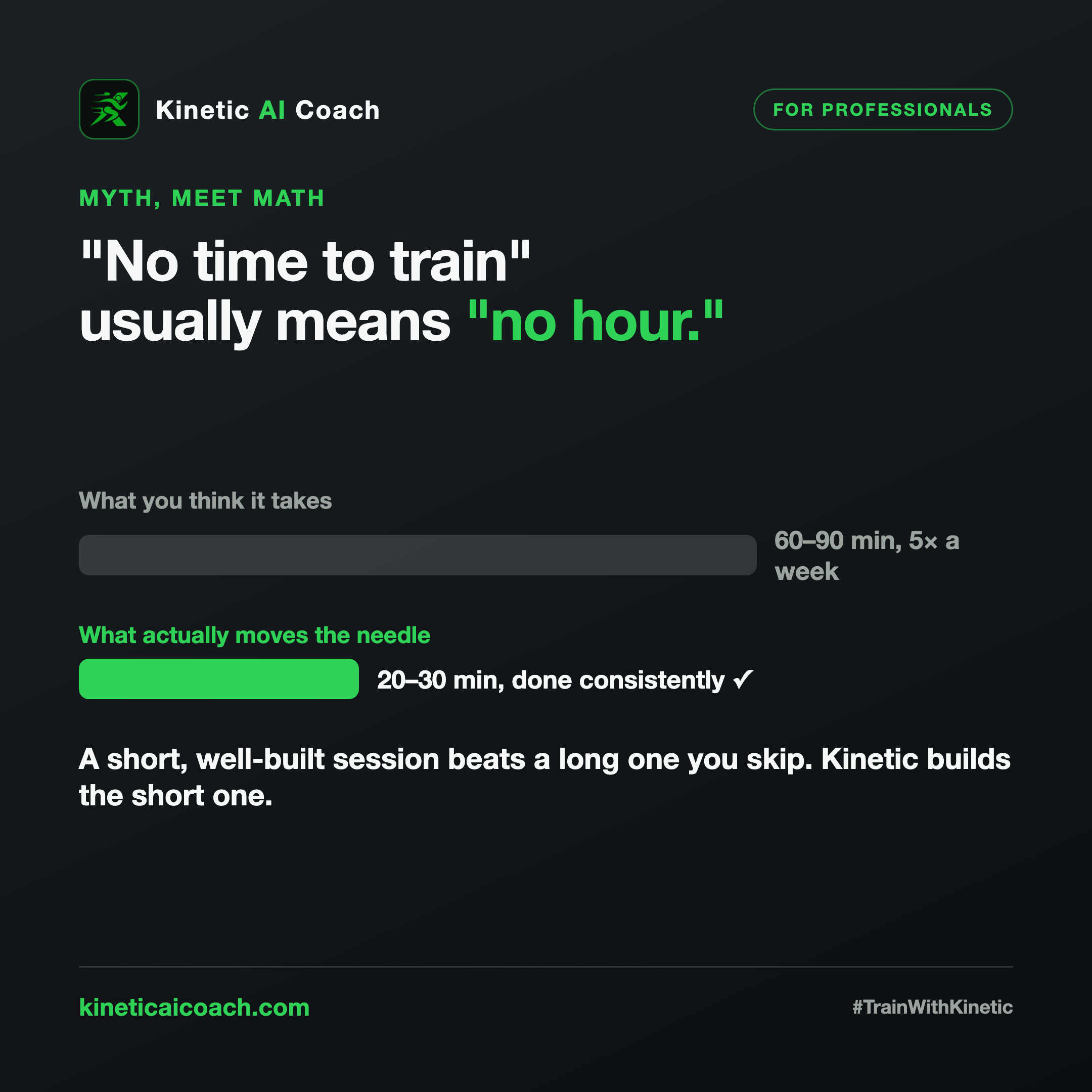
When people say they do not have time to train, they almost never mean they have zero minutes. They mean they do not have an hour — an uninterrupted, gym-clothes-on, drive-there-and-back block of time. Measured against that standard, most days fail, so most days become rest days by default.
But the hour is a self-imposed standard, not a requirement. The idea that a workout has to be long to count is left over from a culture that confused duration with effort. A focused, well-structured 20 to 30 minute session can deliver a real training stimulus — enough to drive the adaptations you are actually training for.
The comparison that matters is not the 20-minute session against the 90-minute one. It is the 20-minute session you will actually do against the 90-minute one you keep skipping. The long workout only wins on the days it happens, and for a busy professional those days are rare. Over a month, the short session done consistently wins easily, because it accumulates while the long one keeps getting postponed.
Shortening the session also lowers the barrier to starting, which is where most training is won or lost. A 20-minute workout is hard to talk yourself out of. You can fit it before the day starts, between meetings, or after the kids are down — slots an hour-long session could never reach.
Kinetic AI Coach builds the short session deliberately, around the time you actually have, so the limiting factor stops being a free hour you rarely get and becomes twenty focused minutes you almost always can. Train in the time you have, not the time you wish you had.